


Architecture in the Digital Realm: How Project Websites Become Designed Experiences
- Lia von Dombrowski

- 5 days ago
- 2 min read
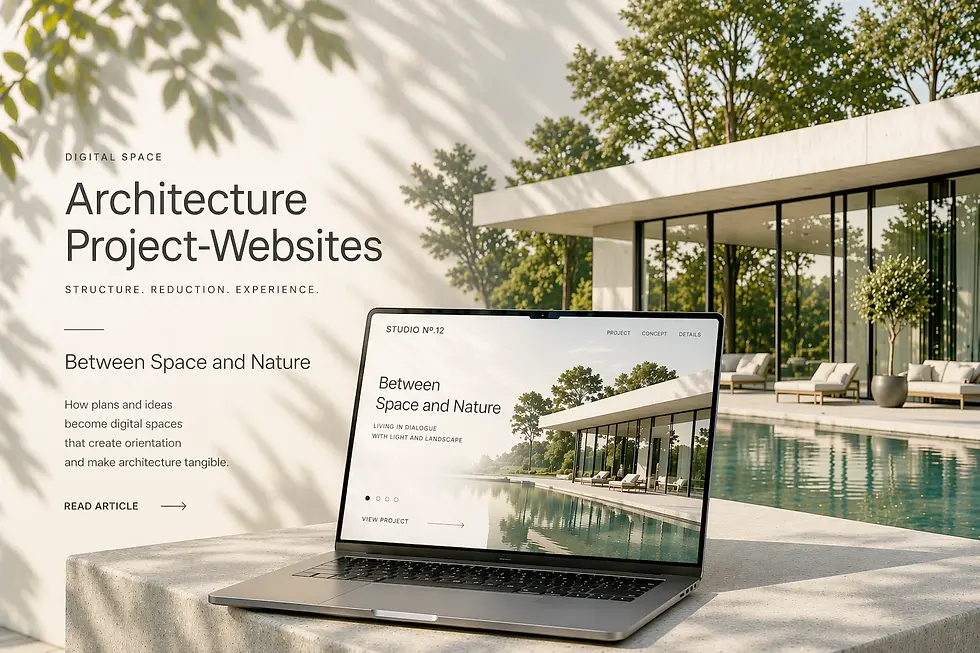
Good architecture never resides solely in what is visible. It operates through order, rhythm, and the precise articulation of relationships. The same holds true for digital spaces. A project website is not a collection of information, but a constructed context—an intellectual architecture that determines whether a project is understood or merely observed.
At its core, this is an act of translation: from space into structure, from atmosphere into interface, from idea into navigation. Those who take this translation seriously do not simply design websites—they create experiences.
From Design to Digital Dramaturgy
Every architectural project follows an internal logic. Paths are not accidental, sightlines are deliberate, transitions carefully composed. This dramaturgy can be carried into the digital realm—not through literal representation, but through interpretation.
A well-conceived project website develops its own narrative structure from plans, images, and text. It determines what appears first, where depth unfolds, and when reduction becomes essential. The result is a form of guidance that does not explain, but intuitively leads.
Navigation as Spatial Thinking
Navigation is often understood functionally—as a means to an end. In reality, it is an architectural instrument. It defines hierarchies, opens or limits spaces, and provides orientation without demanding attention.
An intelligent navigation structure does not think in menu items, but in layers. It creates transitions instead of ruptures, continuity instead of fragmentation.
The user does not move through pages, but through a coherent system—much like moving through a building.

Reduction as an Intellectual Decision
The greatest challenge rarely lies in an excess of content, but in the absence of a clear stance towards it. Reduction is not an aesthetic gesture, but a curatorial act. It requires selection, prioritization, and the courage to leave things out.
Complex projects require clarity, not simplification. A precise digital representation can convey depth without getting lost in detail.
It shows enough to be understood—and leaves enough open to sustain interest.
Consistency as an Expression of Intent
A project website reveals its strength not in isolated elements, but in their interplay. Typography, imagery, structure, and interaction form a system that remains consistent across all layers.
This consistency is not an end in itself. It communicates reliability, reinforces the perception of the project, and translates its character into a digital language. The result is a presence that feels deliberate rather than arbitrary—defined by a clear design attitude.
The Digital as an Independent Space
It would be a misunderstanding to view the project website as a mere extension of built architecture. It is an independent space with its own rules—faster, more accessible, yet also more ephemeral.
Precisely for this reason, it carries a particular responsibility: to condense, structure, and make accessible without flattening the project’s complexity. It is not documentation, but interpretation.
Conclusion: When Structure Becomes Experience
An outstanding project website emerges where architecture is not only presented, but reinterpreted. It translates spatial principles into digital logic, creating an experience that is clear, calm, and deeply resonant.
In the end, what remains is not an informational medium, but a designed platform—one that does not describe, but allows to be experienced.


