Flexibility costs twice
- Lia von Dombrowski

- 2 days ago
- 2 min read
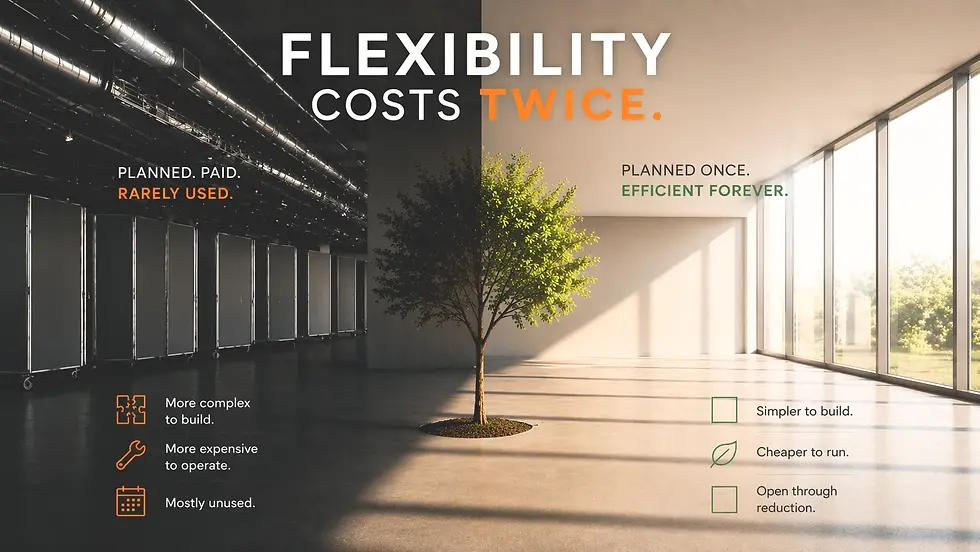
Why perceived freedom is often more costly than clarity
Flexibility is one of the most frequently cited requirements in architecture and planning. It seems self-evident—almost unquestioningly positive. After all, who would want to build something rigid when adaptability appears possible? And yet, this is precisely where the misunderstanding begins.
Flexibility as a promise — and as a cost factor
Flexibility is not a neutral concept. It is a deliberate decision that carries technical, economic, and conceptual consequences. A flexible system does not emerge on its own.
It has to be constructed.
With joints.
With interfaces.
With reserves.
These elements are not abstract ideas, but tangible components, planning efforts, and investments. They generate the first bill—during construction. But that is not where it ends.

The second bill: operation and complexity
What is often underestimated:
Flexibility does not exist only in planning — it also lives in operation.
A system that can change must be understood, maintained, and managed. It carries an inherent complexity—regardless of whether its possibilities are ever actually used.
Movable elements must be maintained.
Technical reserves must be inspected.
Systems require knowledge and operational competence.
This leads to the second bill—in ongoing operations. And it is incurred continuously.
The reality: unused possibilities
In practice, a recurring pattern emerges:
Partition walls that allow for every configuration—and remain unchanged for decades
Building services routes prepared for future expansions—that never happen
Floor plans open to everything—and therefore not truly optimized for anything
Theoretical freedom is rarely translated into real change.
Flexibility is planned, paid for—and not used.
The countermodel: neutrality
The concept of flexibility is opposed by another principle: neutrality.
Neutrality does not mean that a space can do everything. Rather, it means that it prevents nothing. Instead of movable systems and preconfigured options, a space emerges that remains open through its simplicity:
Clear structures
Reduced technical dependencies
No built-in constraints
Change does not occur here through retrofitting, but by removing resistance.
Weniger System, mehr Raum
Ein neutrales System verzichtet bewusst auf eingebaute Möglichkeiten.Es setzt nicht auf Anpassung durch Technik, sondern auf Offenheit durch Reduktion.
Keine Gelenke.
Keine Reserven.
Keine versteckte Komplexität.
Das Ergebnis ist kein weniger leistungsfähiger Raum – sondern ein robusterer.
Die wirtschaftliche Perspektive
Der Unterschied zwischen Flexibilität und Neutralität ist nicht ideologisch.Er ist messbar.
Flexibilität verursacht doppelte Kosten: beim Bau und im Betrieb
Neutralität verursacht einmalige Kosten: überwiegend beim Bau
Im Betrieb bleibt sie nahezu kostenfrei, weil nichts gewartet, angepasst oder verstanden werden muss.
Fazit: Eine Frage der Haltung
Die Entscheidung für Flexibilität oder Neutralität ist keine technische Detailfrage.Sie ist eine grundlegende Haltung zur Planung.
Flexibilität verspricht Möglichkeiten – und verlangt dafür permanente Investitionen.
Neutralität verzichtet auf Versprechen – und schafft dadurch reale Freiheit.
Der Unterschied zeigt sich nicht im Entwurf. Sondern in der Abrechnung.