Pre-design as a strategic lever: Why excellent projects take shape long before the first draft
- Lia von Dombrowski

- 3 days ago
- 3 min read

The quality of a project rarely reveals itself only in the built reality. Rather, it takes shape in a phase that is often underestimated—the pre-design stage.
Especially in an increasingly complex market environment—shaped by regulatory requirements, economic pressure, and rising expectations in design and sustainability—the pre-design phase is becoming a decisive differentiating factor. It is not preparation in the conventional sense, but a discipline in its own right: analytical, strategic, and at the same time visionary.
Clarity before creativity: the strategic project preparation
At the beginning lies not form, but understanding.
A well-founded needs analysis reveals what a client truly aims to achieve—functionally, emotionally, and economically. From this, viable usage and operational concepts are developed, whether for residential, commercial, or hybrid properties.
This phase is complemented by feasibility studies that precisely explore technical, legal, and economic parameters. Site analyses at both micro and macro levels, along with competitive and benchmark analyses, further sharpen the understanding of a project’s true potential.
The result: sound decision-making foundations instead of assumptions.
Identifying potential before it becomes visible
A plot of land or an existing property is rarely what it appears to be at first glance.
Through structured due diligence, opportunities and risks are systematically uncovered. Zoning and planning law assessments clarify at an early stage what is actually feasible—from utilization and setbacks to regulatory constraints.
Volume and area studies translate these insights into concrete scenarios, while initial financial assessments and risk analyses enable a realistic evaluation of approvability, costs, and timelines.
This creates certainty in a phase that is otherwise defined by uncertainty.
Economic viability as an integral part of the planning process
A project is always also an investment.
Early-stage project calculations define a reliable budget framework and create transparency around cost structures. Return and scenario analyses make it possible to weigh different development strategies against one another.
At the same time, they establish a solid foundation for financing documentation—an essential factor for investors, family offices, and institutional partners.
Pre-design thus becomes the interface between idea and capital.
Vision as a strategic foundation
Long before the first architectural design takes shape, a project requires a clear conceptual and design direction.
Architectural guiding principles, mood boards, and defined stylistic worlds create orientation and consistency. Sustainability strategies—from ESG criteria to material selection—are not added retrospectively, but integrated from the very beginning.
At the same time, the user experience within the space is conceived:
How do people move through the building?
What kind of atmosphere is created?
What identity is conveyed?
Particularly in commercial projects, this phase is complemented by brand and identity development—an essential lever for differentiation in the market.
Structure creates speed
Complex projects rarely fail due to a lack of ideas—but rather due to a lack of structure.
A clearly defined project strategy, including a roadmap and overarching timeline, provides orientation for all stakeholders. Stakeholder management ensures that interests are identified and coordinated at an early stage.
The selection and coordination of specialist planners, as well as the definition of the procurement strategy—whether through a general contractor or individual tenders—establish the operational foundation for efficient execution.
What is clearly structured here saves time, costs, and friction later on.
Approvals begin before the design
The dialogue with authorities is not a formal act, but a strategic process.
Early preliminary discussions make it possible to realistically assess approvability and work toward it in a targeted manner. Strategies for creating planning rights or repurposing existing properties are developed proactively rather than reactively.
This significantly reduces risks—and creates a level of planning certainty that is rarely achievable in later phases.
Differentiation through depth
Excellent pre-design goes beyond traditional services.
It encompasses acquisition advisory, independent second opinions, and systematic value engineering—meaning the early optimization of costs and quality.
Future-oriented topics such as digitalization (smart building, BIM strategies) are also anchored at this stage. Even interior concepts are not developed as a subsequent layer of decoration, but as an integral part of the overall idea—well before the actual architectural design.
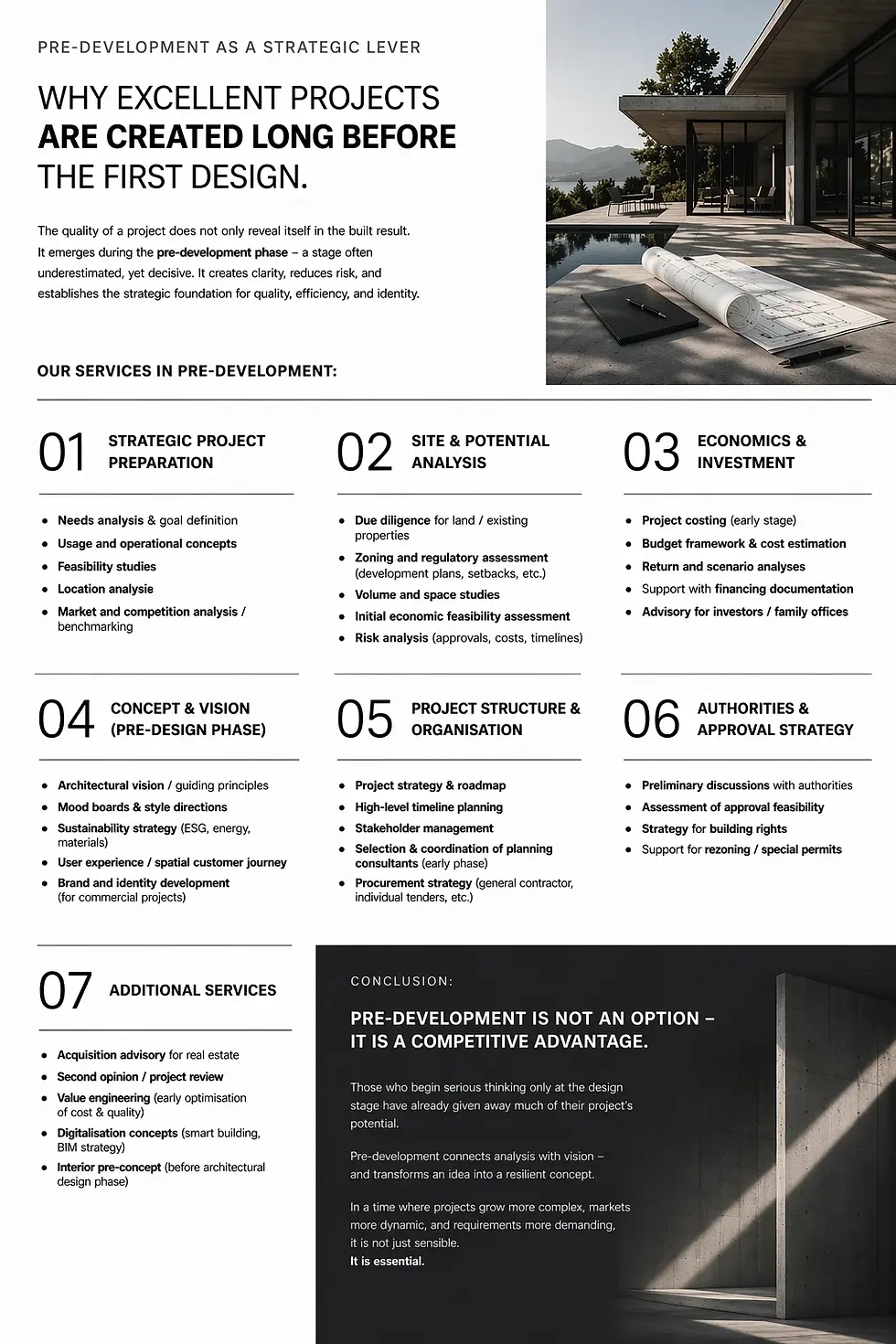
Fazit: Vorprojektierung ist keine Option – sondern ein Wettbewerbsvorteil
Those who only begin to think seriously about projects during the design phase have already forfeited a large part of their potential.
Pre-design creates clarity, reduces risks, and lays the strategic foundation for quality, economic viability, and identity. It connects analysis with vision—and turns an idea into a robust concept.
In a time when projects are becoming more complex, markets more dynamic, and demands higher, it is not merely beneficial—it is essential.